






— DGP PUNJAB GAURAV YADAV CALLS FOR SEAMLESS INTER-AGENCY COORDINATION AND INTELLIGENCE SHARING TO COMBAT EMERGING SECURITY THREATS
— NRPCC WILL CONTINUE TO FUNCTION AS A UNIFIED PLATFORM FOR COLLECTIVE PROBLEM-SOLVING AND COLLABORATIVE ENFORCEMENT, SAYS DGP GAURAV YADAV
CHANDIGARH, September 8:
In a major push to reinforce internal security and foster inter-state coordination, Punjab Police on Tuesday hosted the 10th Northern Regional Police Coordination Committee (NRPCC) meeting to devise joint strategies against cross-border terrorism, gangster syndicates, organised crime networks, and cybercrime.
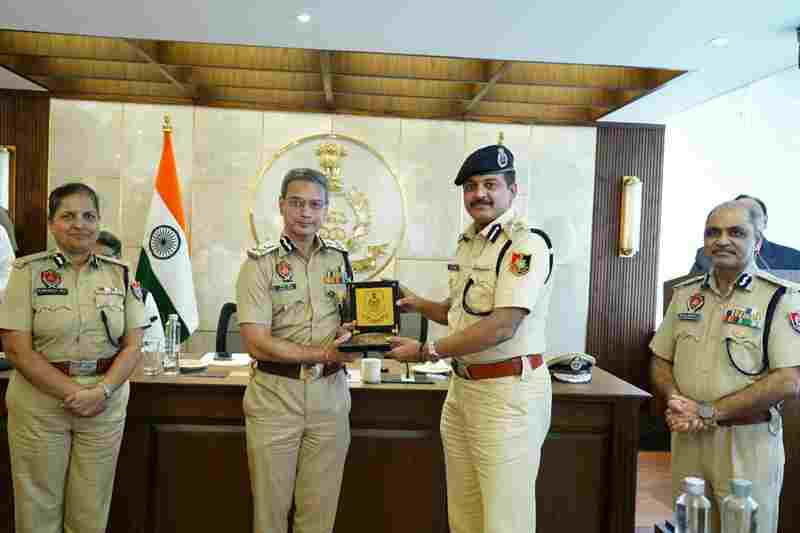
The high-level meeting, held in a hybrid mode, was chaired by Director General of Police (DGP) Punjab Gaurav Yadav and attended by Special Director General of Western Command Border Security Force (BSF) Chandigarh Satish S. Khandare, IG Headquarters Western Command Indo-Tibetan Border Police (ITBP) Rajesh Kumar, IG Punjab Frontier BSF Dr Atul Fulzele and DGP Chandigarh Dr Sagarpreet Hooda, while, DGP Uttrakhand Deepam Seth and DGP Ladakh Anand Kumar Jain joined the meeting virtually. Senior representatives from Central Reserve Police Force (CRPF), National Investigation Agency (NIA) and Subsidiary Intelligence Bureau (SIB), besides State Police forces from Haryana, Delhi, Uttar Pradesh, Jammu & Kashmir, Himachal Pradesh, Chandigarh, and other central and security agencies also joined the deliberations.
Stressing on the need to institutionalise inter-agency coordination, DGP Gaurav Yadav said that NRPCC will continue to function as a unified platform for collective problem-solving, collaborative enforcement, and robust prosecution to ensure safety and security across the region. “At its core, NRPCC is about COORDINATION. As crime and security threats increasingly transcend State boundaries, effective intelligence sharing, seamless inter-agency coordination and swift joint action are critical to staying ahead of emerging threats,” he said.
The DGP said that our collective fight against organised crime, gangster networks, cybercrime, online extremism and other emerging security challenges demonstrates the strength of coordinated policing and inter-state cooperation.
During the meeting, Special DGP Traffic AS Rai delivered a presentation on Punjab’s flagship Sadak Surakhia Force (SSF), detailing its remarkable 52.87% reduction in road fatalities, response time of 6 minutes and 41 seconds, and rescue of over 60,570 citizens across 56,283 road incidents—a model widely appreciated by DGP Ladakh, who expressed his interest in learning from the SSF model of Punjab.
IGP Counter Intelligence Ashish Choudhary highlighted that Punjab Police has constituted the Overseas Fugitive Tracking and Extradition Cell (OFTEC) to pursue offshore fugitives orchestrating crime and terror from abroad. Since 2024, a total of 17 fugitives have been deported or extradited to India—including nine through OFTEC—while eight other fugitives have been arrested abroad via coordinated operations.
Emphasising border security and anti-drone measures, DIG Anti Narcotics Task Force (ANTF) Akhil Chaudhary in his presentation highlighted steps taken to curb the cross-border smuggling of arms and narcotics via unmanned aerial systems. He noted that Punjab has operationalised three anti-drone systems alongside 64 dedicated nakas manned by nearly 600 personnel are being operated for 24×7 monitoring and surveillance to detect and respond to drone-related threats.
Presentations were also delivered by police forces of Haryana, Delhi, Chandigarh, J&K, Himachal Pradesh, Uttar Pradesh, Uttrakhand and Ladakh on on the various themes, including leveraging Artificial Intelligence (AI) and other emerging technologies for policing, monitoring of Inter-State Terrorist-Gangster-Criminal Nexus – Interstate Coordination, New Criminal Laws, Combating Cyber Crime, Social Media Monitoring, etc.
Meanwhile, the meeting concluded with a formal vote of thanks delivered by ADGP Counter Intelligence Amit Prasad.

