







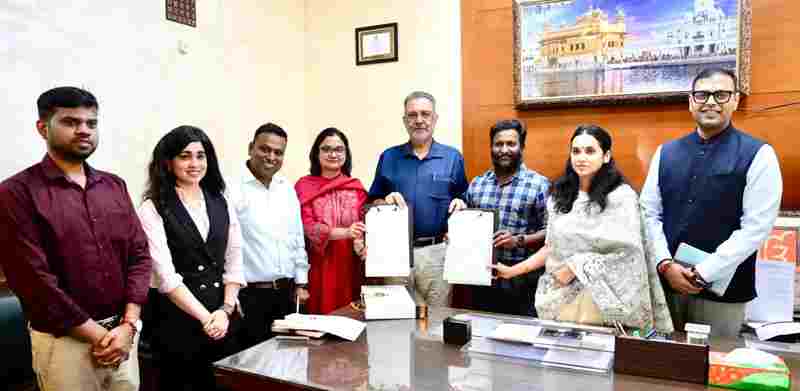
— HEALTH DEPARTMENT INKS MOU WITH KIRAN CORPORATION MUMBAI FOR DRONE-OPERATED LARVICIDE SPRAY IN PATIALA HOTSPOTS
— WE ARE STEPPING UP OUR WAR AGAINST VECTOR-BORNE DISEASES WITH CUTTING-EDGE TECHNOLOGY: DR BALBIR SINGH
— HEALTH MINISTER CREDITS ‘HAR SHUKARVAR DENGUE TE VAAR’ CAMPAIGN FOR BRINGING DENGUE DEATHS TO ZERO AND CURBING CASELOAD ACROSS STATE
Chandigarh, October 12:
In a pioneering move to leverage modern aerial technology in the fight against vector-borne diseases, Chief Minister Bhagwant Singh Mann led Punjab Government has roped in advanced drones to trace and destroy mosquito larvae in hard-to-reach areas. In this regard, the Department of Health and Family Welfare, Punjab, on Monday signed a Memorandum of Understanding (MoU) with M/s Kiran Corporation/SPV, Mumbai, to initiate a 60-day emergency drone-operated larvicide spray operation in identified dengue hotspots of Patiala district.
The MoU was signed in the presence of Punjab Health and Family Welfare and Medical Education & Research Minister Dr Balbir Singh by Director Health and Family Welfare Dr Hitinder Kaur on behalf of the Department of Health & Family Welfare, Punjab, and Sachin Shetty on behalf of Kiran Corporation, Mumbai.
Speaking on the occasion, Dr Balbir Singh said that the Chief Minister S. Bhagwant Singh Mann-led Punjab Government is leaving no stone unturned to combat vector-borne diseases and is adopting tech-driven interventions to stay ahead of outbreaks. “Instead of merely reacting to dengue cases, our prime focus is on actively hunting down and destroying dengue larvae. Many large stagnant water bodies, rooftop accumulation points, abandoned plots, and congested localities remain inaccessible for conventional manual spraying. Drones will now act as our aerial eyes and sprayers to neutralise high mosquito breeding grounds with precision,” the Minister asserted.
Dr Balbir Singh highlighted that the state’s proactive approach—spearheaded by the intensive mass awareness drive ‘Har Shukarvar Dengue Te Vaar’—has delivered landmark results on ground. He credited the weekly source-reduction campaign, active door-to-door larvae surveillance, and robust community mobilisation for reducing dengue cases substantially across Punjab and bringing dengue-related deaths down to zero this year.
Giving details of the project, the Health Minister said that under this 60-Day Emergency Vector Control Cycle (Phase-I), drones will be deployed in identified dengue hotspots and high mosquito-breeding pockets of Patiala district, which had recorded a high disease burden in 2025. The intervention encompasses aerial spraying of government-approved larvicides/insecticides, daily field reporting, and stringent outcome monitoring through scientific larval and adult mosquito density surveys.
The Health Department will facilitate hotspot identification, requisite clearances, local coordination, and technical supervision. Dr Balbir Singh underlined that the entire 60-day initiative is being executed on a non-financial basis, involving no financial transactions from the state exchequer. A comprehensive joint review will be undertaken within 10 days of the project’s completion to evaluate the dip in larval density and plan further phase-wise scale-up across other districts.
Special Secretary Health-cum-MD National Health Mission (NHM) Sakshi Sawhney, MD Punjab Health Systems Corporation (PHSC) Gautam Jain, and State Programme Officer (NVBDCP) Dr Arshdeep Kaur were present during the MoU signing ceremony.

