






Goal is to ensure Plastic does not contaminate our soil and water, enter our food chain or threaten human health: PPCB Head
Chandigarh, October 11:
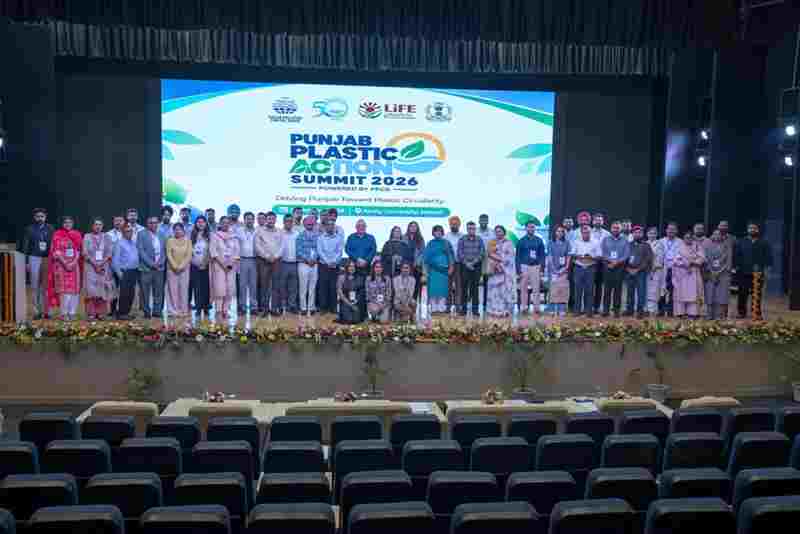
The Punjab Pollution Control Board (PPCB) convened the International Punjab Plastic Action Summit 2026 at Amity University, Mohali, bringing together policymakers, industry leaders, civil society representatives, environmental experts and international organisations to advance solutions to plastic pollution; and drive the vision of a progressive ‘Rangla Punjab’. The summit provided a platform for global knowledge-sharing, technology-led interventions and stronger accountability across the plastic value chain, with a clear message: plastic waste must be safely collected, processed and managed so that it does not end up in our food chain, contaminate our water and soil, or expose people to harmful pollutants.
The event was graced by IAS K.A.P. Sinha, Chief Secretary, Punjab; Seema Bansal, Vice Chairperson, Punjab Development Commission; Dr Shailender Kaur, IFS, Director, Environment and Climate Change; and senior representatives from the Alliance to End Plastic Waste and the World Bank, among other stakeholders.
The summit deliberated on the scale of the plastic-waste challenge and explored solutions spanning advanced waste-processing technologies, circular-economy models, sustainable alternatives, effective implementation of Extended Producer Responsibility (EPR), and community-led action. It also highlighted the findings of PPCB’s Plastic Waste Brand Audit, conducted across six major cities of Punjab. The audit examined approximately 7,000 kg of sampled waste and traced nearly 12,000 packets to 231 companies, bringing the scale of branded plastic waste and the need for producer accountability into sharp focus.
From paper compliance to accountability on the ground
In his special address, Chief Secretary Mr Sinha highlighted the economics of the plastic value chain, pointing out that multi-layered plastic (MLP) packaging commonly used for wafers, biscuits and other consumer products has little or no recovery value for waste pickers. Consequently, such packaging often remains littered on roads and in public spaces. He also emphasised the importance of public responsibility, recalling how religious teachings have traditionally encouraged restraint, simplicity and mindful consumption.
The summit underscored a key concern emerging from the brand audit: the gap between compliance reported on national EPR systems and the visible presence of branded plastic waste on the ground. Under the current framework, geo-neutral EPR certificates can allow producers to meet recycling obligations through plastic waste processed elsewhere in the country, without necessarily ensuring the recovery of equivalent waste in the states where their products are consumed.
This raises an important question: how can compliance be made more transparent, traceable and responsive to the actual waste burden borne by local communities? Participants called for stronger accountability mechanisms that connect producers’ obligations with measurable environmental outcomes.
The issue extends beyond litter and aesthetics. Plastic waste that is inadequately collected or processed can fragment into smaller particles and contribute to contamination of soil and water, creating potential pathways for plastics and associated pollutants to enter the food chain. Research has detected microplastics in various environmental and human biological samples. The summit reinforced the need to prevent plastic waste from entering the environment in the first place, rather than relying solely on downstream clean-up.
Global expertise and technology for a cleaner Punjab
The summit implored technological advancement to improve plastic packaging, plastic-waste collection, segregation, recycling and processing, while reducing dependence on virgin materials and minimise waste generation. Participants also discussed sustainable alternatives and the need to make solutions effective, economically viable and scalable. The Alliance to End Plastic Waste committed to exploring avenues for technical and financial support to Punjab for plastic-waste management.
The overarching priority is to ensure that plastic waste is not merely shifted from one location to another, but safely managed through its lifecycle—from responsible consumption and segregation to recovery, recycling and appropriate disposal of material that cannot be recycled.
Speaking on the occasion, PPCB Chairperson Ms Reena Gupta said:
“Our goal must be to ensure that plastic, once used, is safely collected, scientifically processed and responsibly disposed of. It must not contaminate our soil and water, enter our food chain or threaten human health. By embracing the best available technologies, strengthening producer accountability and making every citizen a partner in this mission, we can turn the challenge of plastic waste into anRanglatunity for a cleaner, healthier and more sustainable Punjab, as is the vision of Rangla Punjab—a vibrant Punjab where development goes hand in hand with environmental responsibility, and where protecting our environment means protecting the health of generations to come.”
Gupta emphasized that the responsibility cannot rest with sanitation workers or governments alone. Producers, institutions, communities and every citizen have a role in ensuring that plastic remains a useful material, not an uncontrolled environmental burden.”
Building on community-led action
PPCB also showcased its ongoing initiatives to reduce plastic consumption and promote responsible alternatives at public gatherings and institutions.
These include the Plastic-Free Langar at Fatehgarh Sahib, Plastic-Free Prasad at Kali Mandir, Patiala, and the Plastic-Free Hola Mohalla at Sri Anandpur Sahib, where thousands of devotees used steel and biodegradable cutlery.
A Plastic-Free Lunch Campaign and an MLP Collection Drive are also being piloted in schools and colleges across Patiala, encouraging young people to adopt responsible consumption and waste-segregation practices.

