

•ECI’s credibility has been systematically eroded, says Aman Arora
- Industries Minister calls the 2023 law a case of “institutional capture”
Chandigarh, October 23:
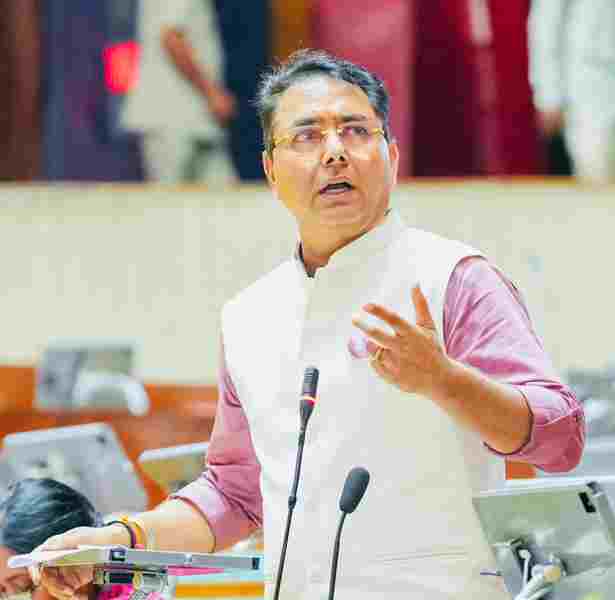
Launching a scathing attack on the BJP-led Union Government, Punjab Industries and Commerce Minister and AAP state president Mr. Aman Arora on Friday said that India’s electoral democracy is facing its “gravest institutional crisis” in decades, warning that the Election Commission of India (ECI) has been systematically stripped of its autonomy and the country is being pushed towards an “elected dictatorship.”
While participating in the discussion on a crucial resolution seeking constitutional safeguards to protect the voting rights of eligible citizens, Mr. Aman Arora paid tributes to Punjab’s freedom fighters and revolutionaries who laid down their lives for the country’s independence and for the right to vote. Recalling Dr. B.R. Ambedkar’s vision of equality at the ballot box, he asserted that the right to vote is not a privilege but the very foundation of democratic citizenship.
Mr. Aman Arora said the crisis was not about any individual Election Commissioner but was structural in nature. He pointed out that two Election Commissioners had raised objections about not being heard and their dissent being repeatedly ignored. Flagging lingering questions over EVMs and the functioning of the ECI, he said the nationwide protests by youth reflected a deepening public distrust in the electoral process.
“The issue is not limited to one Gyanesh Kumar. Tomorrow, whoever comes will have to function within the same system, because the strings are being pulled by those in power,” Mr. Aman Arora stated, while adding that a democracy does not survive on power alone; it survives on the perception of honesty and fairness.
Drawing parallels with the past, Mr. Aman Arora recalled former Chief Election Commissioner T.N. Seshan, who in 1995 suspended elections in Bihar four times amid large-scale booth capturing and refused to hold polls until paramilitary forces were deployed, despite pressure from the then government. He also cited former Election Commissioner Ashok Lavasa, who had objected to Prime Ministerial speeches during 2018-19 and later left the country to join the Asian Development Bank as Vice-President, calling the departure of such officers a loss to national institutions.
He also referred to earlier political attempts to reshape the ECI, including the move from a single-member to a three-member Commission, and said institutions like the ECI must not only be independent but must also appear to be independent.
Training his guns on the 2023 law governing the appointment of Election Commissioners, Mr. Arora said the selection committee- which earlier comprised the Prime Minister, the Leader of Opposition and the Chief Justice of India- has been reconstituted by replacing the Chief Justice with a Union Minister, leaving the Leader of Opposition in a minority. He also flagged the provision that allows the selection committee to consider “any other person” beyond the panel shortlisted by the search committee.
This structure creates a scenario where the accused is also the investigator, the lawyer and the judge. What this law means is that the ruling party can orchestrate the process, commit the crime and pass the judgment, he said, adding that the committees were merely ornamental while effective powers remained with the government.
Reminding the House of Punjab’s legacy in the freedom struggle, Mr. Arora said the responsibility of defending the Constitution now rests again on the people of the state. He strongly supported the resolution brought by Chief Minister Bhagwant Mann-led Punjab government to protect the integrity of the electoral process.
“This is not a fight for one person or one party. It is a fight to preserve the soul of the world’s largest democracy. If the system is not restored, every future government will be forced to operate within a compromised framework. The survival of a 1.5-billion-strong nation depends on the people’s faith in the fairness of the democratic process,” Mr. Arora asserted.

